Posts

Showing posts with the label equanimity

Buddha's Worldview

Image
Many seekers know that whatever is good, happy and joyful in their life is an affirmation of their good karma and spiritual worth. However, from a Buddhist point of view it is also seen as an open door into the feel good craving of worldly spirituality. For some who have embraced Buddhism as a path, their Buddhism is on the other side of their life trying to be honest about their shortcomings so t hat the dharma can fix their problems. This is the dilemma of those in preparation for awakening…. still attracted to the pleasant, and attracted to what brings them happiness. Now we must use honesty in a new way and establish a fresh connection between our Buddhism and our worldly version of spirituality. I am not speaking to the choir here; I am speaking about suffering, because perhaps at this point in the spiritual career of most, they are not prepared to give up craving for the pleasant. True? I have to laugh because even Buddhist spirituality can be worldly. Possessing a new thangka...

Losing Self-Pity and other Buddhist sharing.....

Image
Once you've been looking after the needs of others for some time, caring for others using skillful compassion, you will definitely become more sensitive, tender and gentle. This might be a new feeling for you; it means that you’ve lost sel f-pity. After doing strong Mahayana practices, don’t regress to looking at yourself again because you’re going to cause yourself more pain than the self-cherishing that you had before! Now you’re not constructed to endure self-pity, and it hurts very badly when you do it. ~ Domo Geshe Rinpoche ~~~ "Sobald du dich einige Zeit um die Bedürfnisse Anderer gekümmert und sie mit gekonntem Mitgefühl umsorgt hast, wirst du ganz bestimmt sensibler, zarter und sanfter werden. Dies könnte ein neues Gefühl für dich sein; es bedeutet, dass du dein Selbstmitleid verloren hast. Nachdem du dich in starken Mahayanapraktiken geübt hast, solltest du dich nicht wieder zurückentwickeln und dich selbst betrachten, denn du wirst dir dadurch mehr Schmerzen zuf...

Wisdom, Samsara, the Crabby Mind and other Buddhist musings....

Image
The root of impatience is a determination to offend others. Impatience is the successful method used to control others and establish boundaries.  Impatience is the favorite passive aggressive technique to get things done by intelligent and  kind women.... To change, we must see how it harms and not the successes! Then it is dharma! ~ Domo Geshe Rinpoche ~~~~~ "Die Wurzel der Ungeduld ist eine Art Entschlossenheit, andere zu beleidigen. Ungeduld ist die erfolgreiche Methode, die dazu angwandt wird, andere zu kontrollieren und Grenzen zu setzen. Ungeduld ist die beliebteste passiv-aggressive Technik, um intelligente und gütige Frauen dazu zu bringen, Sachen zu erledigen..... Um uns zu verändern, müssen wir sehen, wie verletzend sie ist und nicht wie erfolgreich! Dann ist dies Dharma!" - Domo Geshe Rinpoche --- I, and so many others really do hope that renouncing samsara is enough.... but sadly, it will not be enough. We must restructure our present dense and subtle pe...

Gods are Real, Rich vs Poor and other Buddhist musings....

Image
Another type of equanimity is deliberately developed in Buddhist training: the dissolution of distinctions held between others and ourselves or between others and still others. The basic premise: all living beings seek happiness and avoid  suffering. To gain this important realization for yourself, remove the distinctions between the wealthy and the poor (in your estimation), or those who live in first world countries and those living in third world countries. Remove the perceptual barriers between the value you place on those who lived ten thousand years ago, those who will live ten thousand years in the future, and those who alive in the world right now. Further, disregard whether a person is a man or women, a doctor or patient, or younger or older than yourself. Do not determine the value of another based on whether they are Tibetan, Chinese or American. All differences are outside of the baseline that is common to all who enter into the human realm. This is dharma! ~ Domo Ge...

Vivid Faith and Enlightened Equanimity

Image
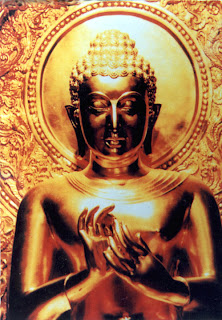
The first kind of faith is vivid faith and can be awakened. You know, at the movie theater, before the movie actually begins, they often have introduction music that starts out very small but it gets louder….”mmmyaaaaaaaa AAAAAAA” A great crescendo! This is how an experience of awakening faith feels. Sometimes a non-Buddhist, when entering a temple for the first time in their life, sees a Buddha statue and cries! They feel a crescendo of joy rising. It is a remembrance of vivid faith. ~ Domo Geshe Rinpoche ~~~~ " Die erste Art von Glaube ist ein lebendiger Glaube und man kann ihn erwecken. Weißt Du, wie im Kino, wenn sie vor dem Filmbeginn oft eine Anfangsmusik haben, die ganz klein anfängt aber lauter wird....'mmmjaaaaAAAAA' Ein großes Crescendo So fühlt sich auch die Erfahrung des erwachenden Glaubens an. Manchmal sieht jemand, der kein Buddhist ist, beim ersten Betreten eines Tempels eine Buddhastatue und muss weinen! Sie fühlen wie das Crescendo...

Really Making Equanimity Stay!

Image
Equanimity will not be accomplished without effort. Once the mind settles into correct equanimity, we will become even more capable of making effort toward the actual awakening. That is because an undisturbed mind is able to act more skillfully. Fake equanimity would be to just give up and not make effort, a kind of deluded passivi ty. This is not equanimity, just inaction by depression. However, if we gain equanimity based on compassion for others, we can go anywhere and do anything! Practice by contemplating the steps to equanimity, such as seven-point mind training, to increase a healthy desire to gain equanimity. By connecting our practice of equanimity to benefiting others in the future, we become capable of profound realizations! In a healthy and balanced manner, we will continue to have normal emotional activity while maintaining discipline over our emotions by the power of our emerging compassion for others. Suppressing emotions gives a temporary peaceful r...

Saving Daylight?.. Equanimity and other Musings

Image
We have been given one more hour of sunlight with daylight saving time... don't waste it.. bring the light into your heart and SHINE! Both a full glass and an empty glass are empty (or devoid) of the very thing we innately believe to be its claim to reality. That error is happening in our own minds, the glasses are simply there due to interdependent causes and conditions. Crystals are a mystery... and completely filled with rainbows! Only need a bit of sunlight to release them.. Think before speaking to edit a more compassionate or dharmic way of life The second kind of equanimity deliberately developed in Buddhism is training toward the dissolution of distinctions we hold between others and ourselves or between others and still others. The basic premise is that all living beings seek happiness and avoid suffering. To gain this realization, remove the distinctions between the wea lthy and the poor (in your estimation), or those who live in first world countries and t...

Impatient with the Buddha?

Image
Enlightened beings, (in human form or other), should never be perceived as objects of our practice of patience. The dharma provides many techniques to generate equanimity, including patience. However patience is correctly directed toward objects, our own karmic problems, or our dysfunctional dynamics with others, excluding bodhisattva s. ~Domo Geshe Rinpoche ~~~ "Erleuchtete Wesen (ob in menschlicher oder anderer Form) sollten niemals als Objekte für unsere Übung in Geduld betrachtet werden. Das Dharma stellt uns viele Techniken bereit, um Gleichmut zu erzeugen, einschließlich der Geduld. Aber es ist korrekt die Geduld auf Objekte zu richten, auf unsere eigenen karmischen Probleme, oder unsere gestörten Beziehungen mit anderen (Bodhisattvas ausgenommen)." - Domo Geshe Rinpoche ---

Peace is Not a Valid Goal

Image
Peace is not a valid goal to work toward, we must work instead on obstacles preventing it from arising spontaneously within the mind! Peace is the experience of equanimity that comes from closure; the end of conflict. In a deeper sense, peace is the end of confusion between how we exist and how we think we exist. ~Domo Geshe Rinpoche ~~~ "Frieden ist kein gültiges Ziel, auf das man hinarbeiten soll. Stattdessen müssen wir an den Hindernissen arbeiten, die verhindern, dass er spontan in unserem Geist aufsteigt! Frieden ist das Erleben von Gleichmut, der daraus entsteht, mit etwas abgeschlossen zu haben: das Ende des Konflikts. In einem tieferen Sinn ist Frieden das Ende der Verwirrung darüber, wie wir existieren und wie wir glauben zu existieren." - Domo Geshe Rinpoche ---"

Unexhausted Equanimity

Image
Equanimity is like owning a powerful flashlight and patience is its working function. However, the power of true equanimity is greater in scope and and remains unexhausted by patience ~Domo Geshe Rinpoche ~~~ "Gleichmut ist als ob man eine kraftvolle Taschenlampe besitzt und Geduld ist ihre Ar...beitsfunktion. Allerdings ist die Kraft des wahren Gleichmuts von größerer Reichweite und wird nicht durch die Geduld erschöpft." - Domo Geshe Rinpoche ---

Did the Ancients Know the Meaning of Equanimity?

Image
Beyond words is meaning, and beyond meaning are concepts. Concepts are connected to a need, and common to all spiritual paths, I believe, is the need to develop equanimity. To do that, we need a way to understand concepts and that is done through agreement on word usage. There are many dictionary and commonly held meanings in English for the word equanimity. The dilemma of poor communication happens when your meaning and my meaning are very different. In long time Buddhist countries, dharma language became standardized. However, even the different concepts within Buddhism often require a unique view of standard dharma words and terms in order develop new understanding or abilities. The word equanimity comes from a Latin root, which translates to equal mind. It is uncertain whether the ancient scholars were looking at it from a political, religious or social point of view and if there were other meanings for the word equanimity in the original Latin. In that way, this particular meaning...

In-equanimity Attracts Problems

Image
The reason why problems arrive is that we have karma from previous negative actions ripening, whether that is from this life or from previous lives. If we approach it right this time, it is possible to not only to exhaust that particular kind of karma that continues to produce the problem, but we can prevent activating it again in the future by letting it cause excessive distress to the mind, the actual cause of further consequences. It will not be accomplished without effort. In fact, we will become more capable of making effort because the mind is not disturbed, and we are able to act more skillfully because of our concentration on developing equanimity. Fake equanimity would be to give up and not making effort. This is not equanimity, but only inaction by depression. We can go anywhere and do anything if we gain equanimity based on compassion for others. Practice to increase a healthy desire to gain skill by connecting our practice of equanimity done, not for our own sake, but to be...

Thought for Sunday on Steady Equanimity (read in Eng,Sp,Fr,Ger,It

Image
In my opinion, there are several types of equanimity to be cultivated in spiritual development toward the transformed state. Number one: Maintaining an even and non-reactive point of view, even in the face of difficulties. An even point of view means neither moving toward an object nor moving away from it. It is doubtful that would be considered neutral. Neutral appears to me as something that is not moving, whereas the concept under consideration here is the attraction toward or repulsion by outer objects. The confusion that arises when we project our own inappropriate likes and dislikes are often arbitrary and unrelated to the situation. Because even more confusion results by continuing to exercise our traumas, personal illogical taboos, and negativity, we suffer more from our projections than the events themselves. Through active will and discipline, we train vigorously to avoid acting upon the associated negativity of the push or pull of compulsion to take back control of our life ...