Posts

Showing posts with the label cogitation meditation

Thoughts on Honesty, Reflection and Doing Good

Image
One kind of cogitation meditation is to ask yourself a question that calls for an inner answer rather than thinking of an answer. A good example of this inquiry might be, “Who was I before this life?” Close your eyes for a short time and ask yourself even though you can see that it is not easily answered. To do an in depth inquiry meditation, it is good to have seclusion. You might want a more undisturbed, peace and quiet to just sit with the question “Who was I before this lifetime?” Another question we can ask ourselves silently is, “Who will I be after this life is finished?” Because these are compelling and important questions, we should not consider this the end of inquiry but only a starting point. I hope that soon you will find time to sit quietly in a comfortable chair to think, or go to the seaside, look out on the ocean, relax and cogitate. ~Domo Geshe Rinpoche ~~~ ""Es gibt eine Art des meditativen Nachdenkens, wobei Du Dir selber eine Frage stellst, die eine inner...

How to Meditate Efficiently

Image
In order to be able to describe how to meditate in the most efficient manner with the best results, we will need to ask other questions and explore other meanings. So, what is meditation? Since you want to know how , exactly what is it? Student: It is a method of going internal. It is a method of internalizing experience. Rinpoche: ok, a method of internalizing experience. However, what if you have just experienced eating a spoiled pizza? Student: Then you cannot meditate. Rinpoche: You should not meditate. So there is something missing in your answer. If you were explaining this to a rank beginner, they might ask, “I have just had a terrible day at work. Should I internalize those experiences?” Student: No, absolutely not. Rinpoche: Good. Student: What I was thinking of was not so much internalizing what is outside, but more paying attention to what is inside. Rinpoche: Alright. Now we have a very different answer. Paying attention to what is inside. However, why wo...

The Chemistry of Change part three

Image
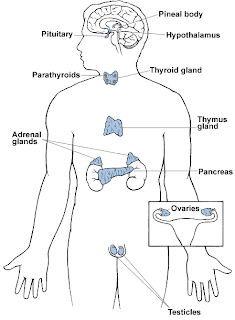
Meditators have a unique opportunity to observe themselves change from a subjective viewpoint. Interesting feelings are happening in the body and mind while the brain becomes rewired for new ways of receiving inner data both during and after minor and major changes. During the experience of transmutation, hormonal activity could be either newly stimulated or brain hormonal activity that was there could become suppressed. This does not mean it always happens this way, but there is a very strong possibility that there is new hormonal activity associated with that processing center, the brain … I am not talking about the mind folks... This is about the processing center that is built for the mind to direct activity that results in causing you to, for example, move an arm or have an idea. This is not the mind. The mind stimulates activity in the brain and part of that process is the hormonal system that activates cascades of chemicals. Now, within the cells of the body, the cellular ...

Chemistry of Change (part one)

Image
We would not be pursuing spiritual subjects or meditation practice unless we wanted to change. Today we begin the topic of what it feels in the body and mind when we are changing inside. This is not just signs of inner spiritual development, as though we were becoming holier every day. The physical and mental changes produce practical and important influence on other areas of life. How we are changing our perceptions by meditation and living by Buddhist principles, changing our minds about what is truth, and seeking reality bears on what kind of career we choose and what kind of relationships we desire to have with others. Spiritual inner change has effects in the physical body, brain, and mental functions that are energetic, chemical, and emotional. In Tibet, we did not discuss change in this way because we have a medical system that explains disease or mental difficulties as imbalances of the three humors and how that affects the mind and body. It also describes how meditation...

Recipe for Enlightenment (part three)

Image
We continue the discussion on cogitation meditation from yesterday. This meditation technique and energetic is like an enfoldment or unfolding of thinking. Rather than looking, thinking, adding more ideas to the thought, you are waiting in encouragement while this enfoldment is drawing forth elements that need to be viewed and understood. This ability only comes with steady practice so not much more needs to be said about this for now. The cogitation meditation results are gathered into realizations. These minor breakthroughs are characterized by the arisal of a new state of mind or new thought patterns. These minor breakthroughs and new states of mind could also be attained by removal of a difficult state of mind or difficult dynamic. With that removal, a careful ingredient that was previously hidden from the meditator becomes exposed. Something you might have already developed in a previous time; this life or another life was hidden by another dynamic. For example, this becom...

Recipe for Enlightenment (part two)

Image
Before Tibetan teachers came to America, there were Buddhist teachers of other traditions; the Zen tradition, as well as from Sri Lanka, Burma, Viet Nam, and other places, who came to the West to teach. Even one hundred years ago, there were Buddhist teachers who came to America telling people about the nature of peace and goodness. They shared their cultural adaptations of ancient Buddhism and told the story of Lord Buddha Shakyamuni's enlightenment, so the transmission of Buddhism is not something that has just happened recently. Before Buddhism came to the West, it went from India to China, Japan, Tibet, as well as many other countries. How marvelous, how wonderful that the sayings and teachings of Lord Buddha Shakyamuni were preserved and written and made available in recipe form for 2,500 years. That is a very long time to maintain and preserve a lineage of teachings. Part of the recipe for enlightenment is contained within the preservation and dissemination of the teach...